Study finds persistent ethnic inequalities in stroke care and outcomes
#inequalities#long-term-outcomes#thrombolysis
Key Findings from New Research
A major study tracking stroke cases in South London over 25 years has revealed important differences between ethnic groups in stroke treatment and outcomes.
Key findings at a glance
What we did and what we found
The South London Stroke Register follows up adults after their first stroke to collect data on their health and the care they get during the months and years after their stroke. Our study has compared Register data from Black Caribbean, Black African and White ethnic groups and we have found important differences between these groups in:
- how old people are when they have a first stroke
- how soon they go to hospital when they have stroke symptoms
- the treatment they get in hospital for the stroke
- how disabled they are after the stroke. We also looked at rates of admission to a stroke unit. Recently, there has been no significant difference between ethnic groups in rates of admission to a stroke unit. We explain the findings in more detail below. The study is published in JAMA Network Open: https://jamanetwork.com/journals/jamanetworkopen/fullarticle/2828870
How old are people from different ethnic groups when they have a first stroke?
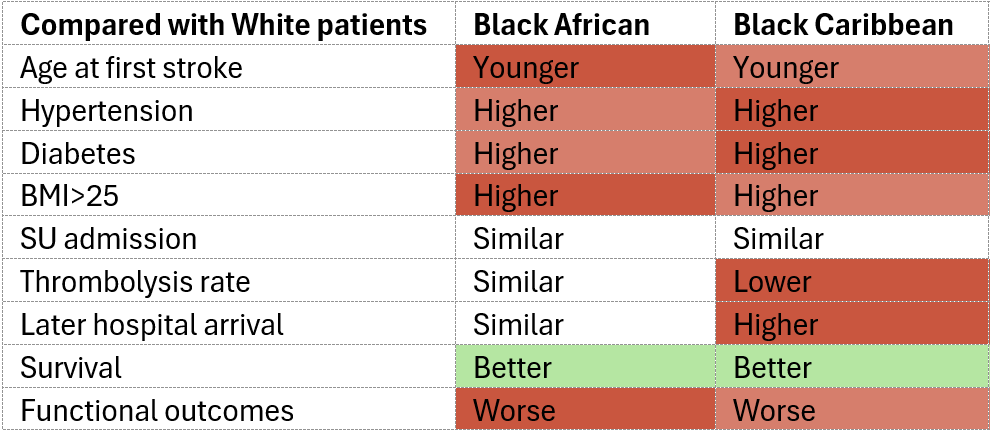
Black participants, especially Black African participants, were significantly younger at first-time stroke than White participants. On average, Black African participants were 59 years old, Black Caribbean participants were 68 years old, and White participants were 72 years old.
Why are Black participants younger than White participants when they have a first stroke?
Black participants had higher rates of health problems which increased their risk of stroke. Health problems included:
- high blood pressure: 75% of Black African participants, 76% of Black Caribbean participants, 62% of White participants
- diabetes: 29% of Black African participants, 40% of Black Caribbean participants, 17% of White participants
- body mass index greater than 25: 69% of Black African participants, 61% of Black Caribbean participants, 52% of White participants.
Hospital arrival times and use of clot-busting treatment vary between ethnic groups
When someone has an ischaemic stroke (when there is a blockage in the blood supply to the brain), a treatment called thrombolysis (using a clot-busting drug to clear the blockage) may be suitable. This treatment needs to be given within about four hours of symptoms starting. Over the years of the study, Black Caribbean patients were less likely than White patients to get thrombolysis. Black Caribbean participants were also more likely to arrive at hospital more than four hours after stroke onset than White patients.
Black participants have worse health outcomes
Black African and Black Caribbean participants had higher levels of disability and inactivity than White participants up to 5 years after stroke, with no significant changes over time.
Apart from ethnicity, what could have influenced the study results?
The worse outcomes in the Black ethnic groups were not fully explained by various factors we used to test the results. (Factors are the variables in the study that we believed could affect the results). The factors we used included:
- sociodemographic factors (the patient’s job, education level, the deprivation level where they lived),
- stroke-related factors (level of disability before their stroke, type of stroke, and several measures of how severe the stroke was)
- the high percentages of Black African and Black Caribbean participants who had factors which increased their risk of stroke (high blood pressure, diabetes, previous heart attack, an irregular heart rhythm called atrial fibrillation, history of smoking, high body mass index)
Recommendations for healthcare planning and delivery professionals
Consider implementing:
- Cardiovascular health-checks for Black African individuals at younger ages, because these patients are significantly younger on average at time of first stroke than other Black Caribbean or White ethnic groups
- Tailored health/education campaigns targeting Black Caribbean patients and their communities, and healthcare professionals, to address late hospital arrivals and low thrombolysis rates. Prevention and management of hypertension and diabetes in primary care is crucial for reducing stroke risk in all ethnic groups.
What was known (about ethnic inequalities in stroke care and outcomes) before this study?
- Many studies have shown that stroke is more common in ethnic minority populations than in White populations.
- Studies reporting ethnic inequalities in care or outcomes are conflicting. These studies often only include hospital-admitted patients and short-term outcomes.
What knowledge does this study add?
- This study looks at long-term outcomes (up to five years after stroke).
- This study includes participants who were not admitted to hospital when they had a stroke as well as those who were admitted to hospital.
Matters for further research
- Understanding reasons for lower thrombolysis rates: Late arrival time at hospital may explain some, but not all, of the lower thrombolysis rates in Black Caribbean participants. Other possible reasons include refusal of treatment.
- Identifying individual (eg, psychological or genetic), sociocultural, and structural (eg, availability and accessibility of health or social services) factors which drive poor poststroke functional outcomes in Black African and Black Caribbean populations in the UK. Poorer outcomes were not fully explained by demographic variables, stroke type or severity, comorbidity profiles, or socioeconomic factors.
More information about the study
- The South London Stroke Register includes people who live in a defined area of South London, UK
- We included 7280 participants in the study
- Participants’ first stroke occurred between 1995-2021
- We followed up participants for up to 5 years.
What work is being done to address ethnic inequalities in stroke care and outcomes?
https://www.england.nhs.uk/long-read/annual-report-on-nhs-englands-work-on-healthcare-inequalities-and-the-nhs-race-and-health-observatory-2/ The gap in stroke hospital admissions by deprivation decile and ethnic group is an NHS KPI (Core20PLUS5 clinical areas) From the Caribbean and African Health Network: https://www.cahn.org.uk/events/campaigns/stroke/ https://www.cahn.org.uk/core20plus5-community-connector-programme/ report on commission to run a Core20PLUS5 initiative in Greater Manchester From the London 'inspire' programme: https://www.inspireblackhealth.london/about/ A programme developed to raise awareness and promote targeted health interventions aimed at reducing the health inequalities faced by Black people in London.