
Equitable and Inclusive Patient and Public Involvement in Stroke Research (EquIPS)
Guidance for those designing and leading work with people and communities.

EquIPS aims to make patient and public involvement more inclusive by thinking about how researchers conduct research and engage stroke survivors, particularly those individuals who experience more severe impacts of stroke e.g. communication difficulties, mobility problems, fatigue, and cognitive difficulties. We want to encourage researchers working with people and communities to consider how we can better support the inclusion of stroke survivors with diverse needs in shaping research.
Researchers need to feel prepared and able to involve and engage stroke survivors with diverse needs. From our initial work in this area, we have found that researchers express a lack of tools and methods, expertise and confidence in practising PPI with those living with diverse, often more severe impacts of stroke. This means the PPI meeting has become the norm, the expected way of doing PPI, rather than one of many tools available that enable lived experience to shape research.
We want to ensure we support stroke survivors in identifying and communicating their needs, and researchers in thinking creatively with how they practise involvement to ensure diverse and inclusive participation.
By inviting stroke survivors and stroke researchers to collaborate on the project, we sought to develop guidance for researchers that supports the inclusion of diverse stroke survivors through critical thinking about the methods we use to involve and engage people and communities. Researchers need to ensure there is an understanding of what to expect from participation in research. We also want to provide both people, communities and researchers with this guidance, with the inclusion of tangible lived experience examples to help start and support conversations about doing people and community engagement with stroke survivors in a meaningful manner. Our focus on stroke specifically sets this work apart from broader (and often helpful) guidance on people and community involvement.
We have, where possible, co-created templates to assist in planning and engagement with activities. Activities involving people and communities provide stroke survivors and their wider support network with a voice, shaping research and projects that affect them. In the sections that follow, we have outlined key areas that our collaborators (stroke survivors and researchers) identified as necessary and meaningful regarding participation and involvement in research.
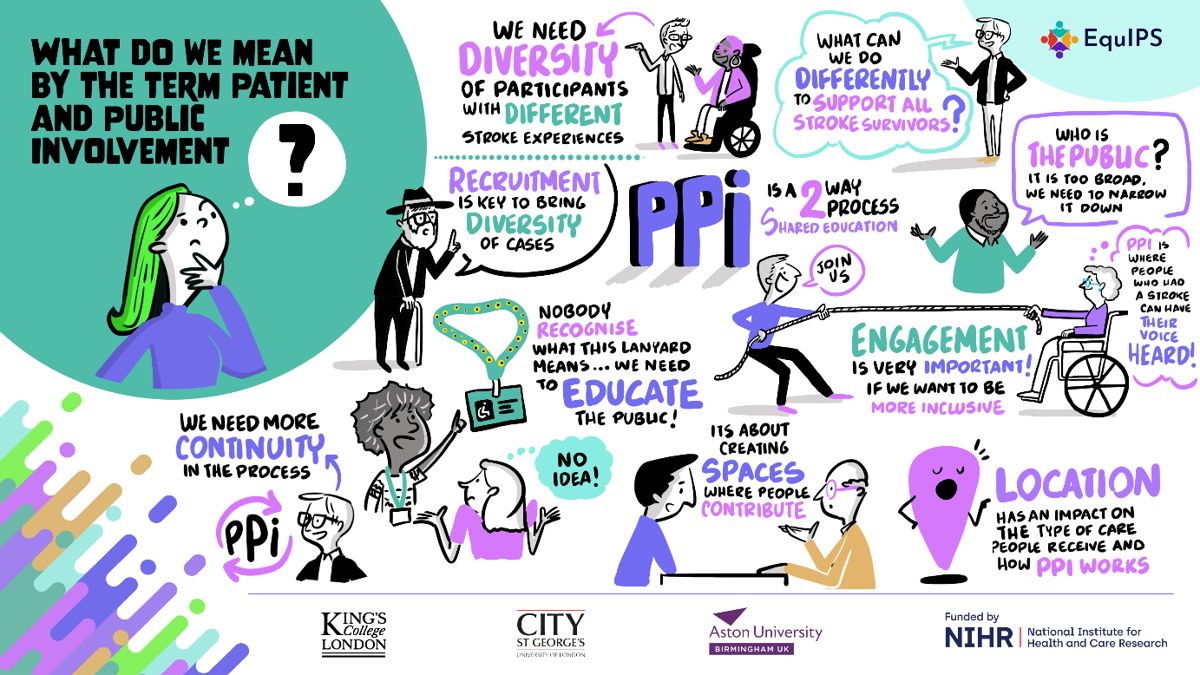
Some of the information below reflects wider guidance. We include because it was important for our collaborators to reiterate, particularly as it remains important to them as they contribute and support research and researchers in their work to improve the lives of stroke survivors.
Starting point: Ask what specific stroke survivors need to participate
Inclusive involvement starts with understanding the needs of the people you hope to involve. The best way to do that is to make space, early on, for stroke survivors and their networks of support to speak to researchers, ask questions, and set out their communication and physical needs in their own terms. Our Participant Needs (still in development) template is built for that conversation, and works better completed together than sent out to be filled in.
Asking first lets a research team work actively to facilitate involvement on stroke survivors' own terms. It also allows the limits of what a project can do, whether because of funding or timescales, to be discussed openly with stroke survivors. Meeting someone's needs then becomes a collaborative exercise rather than something done for them. What people tell you should shape which of the approaches a project offers and inform how involvement is designed next time.
Methods to involve diverse stroke survivors
As highlighted above, our national survey of stroke research teams found that meetings were the main involvement method in almost every project, and that alternatives such as one-to-one conversations or community outreach were treated as additions to meetings rather than as involvement.
Through this project, we compel research teams to consider involvement work as multi-method. Rather than which method, which methods can and will a project offer to support the involvement and input of individuals experiencing diverse impacts of stroke. A project could run a meeting, a few one-to-one conversations and an open channel for recorded contributions, all feeding the same decisions. Offering a choice, and different synchronous and asynchronous ways to participate is crucial for inclusive involvement. It tasks researchers not only with thinking creatively but also reflecting on who participates in involvement activities and whether the design of activities excluded some through when and how their input is sought.
In the following paragraphs, we suggest some ways that stroke survivors could be involved in research. The list is not exhaustive, and we will add to it over time. We are keen to hear more here and include real-world examples. If you would like to contribute, please contact: Dr David Wyatt (d.wyatt1@aston.ac.uk) and Dr Sophie Rowland-Coomber (sophie.rowland@kcl.ac.uk).
Ways of taking part
In people's own time (asynchronous)
A voice note or video recorded on a phone, comments spoken or written onto a draft a posted pack, a text exchange, or a week after a session in which anyone can add what they did not manage to say. This can be done by a proxy if the stroke survivor is unable to communicate directly themselves. These approaches remove time pressure, which helps people with aphasia or dysarthria, and it suits people whose fatigue allows short bursts on a good day. Time and resource are needed however, to facilitate this and make sense of the input that comes back.
Live and together (synchronous)
Meetings, workshops and video calls are still good for building relationships and for decisions that need discussion to crystalise agreed next steps. They ask people to be in one place at one time, follow a live conversation and speak in a group. They are clearly valuable, but as one route to input rather than the route.
One to one, and at home
A conversation at home, in a café, at a clinic or by phone, at the person's own pace are a valuable tool in involvement. This reaches people who cannot travel, who tire quickly, or who will not speak in front of strangers. One of our national survey participants had met most of their contributors this way (see, Wyatt et al. 2026). This is a very time intensive option.
Through groups people already belong to
Taking the activity to a stroke or communication support group, a community organisation or a place of worship that already meets. This reaches people who may never answer a call from the research team directly to contribute. Involving existing groups, however, need the researcher teams to build a relationship with them first, not arriving, getting input and then disappearing. It involves a commitment to longer term engagement. Treat the group's facilitator as a partner, and work with them to identify how best to gain important input and involve group members in the research.
Smaller groups, matched by experience
It is also possible to have several smaller groups rather than one large one, with members matched so they have similar support needs. This means that it is easier to pace the meeting in line with the groups needs and directly adapt practises for those present. It avoids the needs and complexity of trying to meet diverse participants' needs in a single setting.
Creative and non-verbal methods
Photographs, drawing, mapping, timelines, objects and card sorts carry what someone wants to say without relying on speech. To mark 30 years of the South London Stroke Register, members of our patient and family group used photovoice to explore everyday life after stroke and co-produced a video from their own photographs and voices. In this project, participants coproduced the specific research questions, went away and took their own photographs to respond to these questions. Then, as a group, participants began to sort and reduce the photographs to two each. While the photographs themselves were important input, participants were also to explain the significance of the picture verbally or in writing based on their preference. Had a proxy been needed this could have been incorporated to into the participants narration of their photographs (Wang and Burris, 1997).
Bringing contributions together
Adopting a multi-method approach means that individuals and groups contribute to different forms and at different times. In practice, this means sharing summaries with all contributors, in writing and/or orally where a group needs it and being clear about where different input came from. Describe that input by category, such as face-to-face discussion or community group, rather than by named individual, which avoids any GDPR issues. Keeping a record of where a note of which route each point came from, because a point made only by people contributing in their own time is itself a finding.
Before involvement activities
Participating in research involvement can be daunting and overwhelming, especially for people and communities who are new to these types of engagement and involvement, and for those who are unable to interact and/or communicate in the same way that they did before their stroke. As our paper highlights, for researchers, preparing for involvement activities is complex, requiring careful thought, planning and design, as well as substantial logistical and administrative work.
It is important that researchers consider actively and critically how they plan to involve diverse stroke survivors. While the focus of this document is on impacts of stroke, there is a growing body of literature on involving diverse groups in people and community involvement, as seen in the Race Equality Framework and guidance from the INCLUDE project.
As part of budgeting and planning involvement activities, researchers should also consider the type of support people and communities may need (and what the research team can provide). Where possible this should be included in funding applications (although we note that a lot of PPI work happens before research grants are submitted). This might include speech and language therapy provision, funds for additional printing and posting of materials, travel for stroke survivors or for researchers to meet stroke survivors in the community individually or in established groups, and funds to meet caring or childcare costs.
This project invites researcher teams to think about PPI as a core, resourced part of research work and not something that's added on or, when part of a funded project, completed on a shoestring budget.
Communication
Stroke survivors can experience aphasia, muscle weakness that affects speech, voice changes, and cognitive-communication issues that affect how people communicate, including speech, reading, writing and understanding. This does not mean reduced competence. It means communication needs to be adapted. This includes presenting information in short sentences, using plain words, and on PowerPoint slides, presenting one idea per line. Pairing text with images, symbols, or colour-coding can help make things clearer. Extra time and no pressure to respond quickly matter just as much as the words themselves.
Speech and language therapy support is the most valuable thing a team can add to involvement work with stroke survivors who have communication difficulties, and we recommend funding it wherever possible. Most teams, most of the time, will not have a speech and language therapist in the room. There are several structured resources that a research team can use.
The Consent Support Tool, Mark Jayes and Rebecca Palmer (2014), is a structured procedure that profiles a person's language ability and then identifies which format of written information is most likely to support their understanding. It is published as a manual (Palmer and Jayes, 2020) and costs £34.99 for the manual plus £22.50 for a pack of 15 forms. This is something to consider budgeting for.
Alongside it:
- Communication Access UK (Royal College of Speech and Language Therapists) offers free short online training, brief enough for a whole team to complete rather than only the people facilitating.
- The Aphasia Institute's online training in Supported Conversation for Adults with Aphasia teaches the techniques that underpin most of the advice in this section: writing, drawing, gesture and checking back.
- The Collaboration of Aphasia Trialists provides free templates for accessible information sheets and consent forms.
None of these replaces a speech and language therapist. They do, however, highlight that there are things non-SLT researchers can do to develop skills and knowledge to support stroke survivors with communication difficulties within involvement activities.
Involvement works best when researchers offer a choice of communication styles and activities, recognising that stroke survivors will want and need different things.
Respect and inclusion
It is important that researchers provide clear information on the purpose of involvement and expectations relating to involvement and engagement activities. The research team must acknowledge their responsibility to provide clear timelines for the research and involvement work, and guidance on who to contact if necessary within the research team leading the research.
It is important that participants are (and feel) included and valued, with opportunities to ask questions and provide feedback regularly throughout involvement activities. Researchers should ensure that they have clear plans to provide feedback on the impact of involvement activities Feeding back how input has impacted the research is crucial in avoiding involvement being extractive and onesided rather than collborative. Extractive practices can undermine trust. People and communities want to know how they have shaped research projects and outputs.
Accessibility
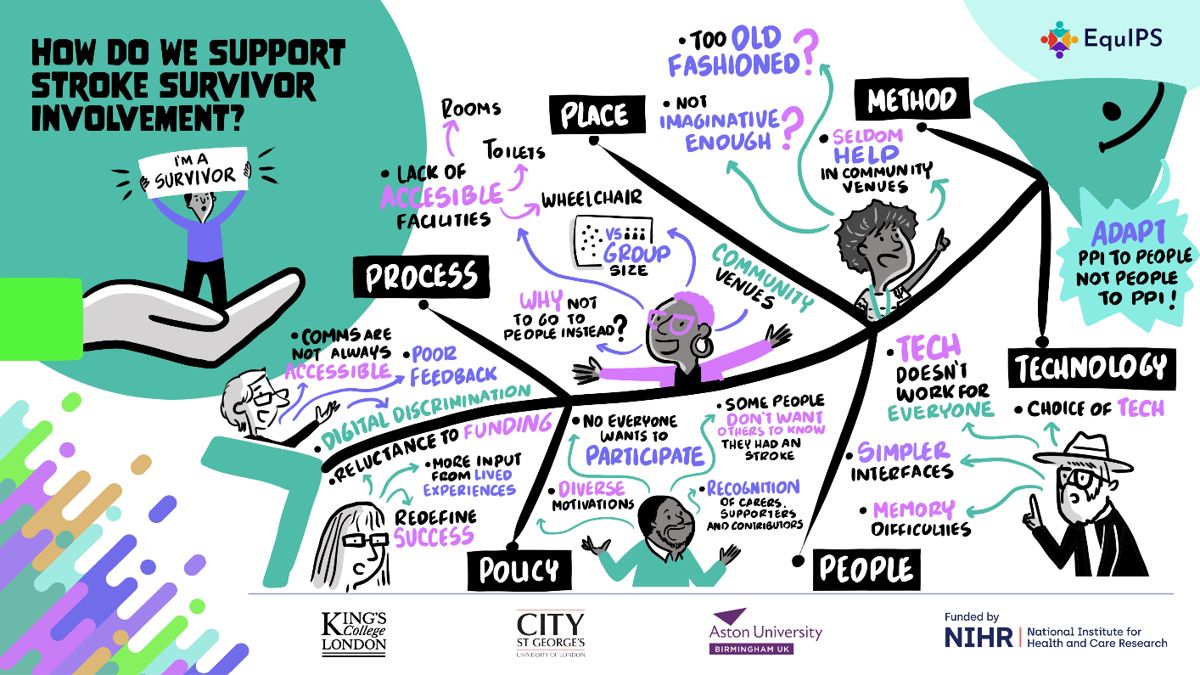
The ability to participate in involvement activities depends on the practical, physical, and emotional conditions surrounding the activity. The Stroke Association have produced Accessible stroke information to assist stroke survivors in research.
Fatigue, mobility, sensory changes, and reduced confidence after a stroke can affect whether people can attend a face to face or online activity, stay engaged, and/or feel comfortable contributing. Removing these barriers isn't about lowering expectations but designing activities so that stroke survivors take part on equal terms. For example, a venue that's hard to reach, or a meeting scheduled at a fatiguing time of day, can exclude people before the session even begins. Physical space is also important: seating, quiet areas, step-free access and accessible toilets. Wherever possible, financial costs of travel, for example, should not be a barrier to participation.
Technology can extend access, but only if it's set up with support. Researchers may need to spend time with stroke survivors to support them in using technology, providing reassurance, encouragement, and ongoing support. Where possible technology should not be the only means by which people participate in research, and in cases where it is researchers need to acknowledge the extra preparation required to successfully engage people and communities in research.
Accessibility also means acknowledging that participation can take many different forms. For example, where people are able it is important that people should be able and confident to attend research sessions. Participants might ask for instructions on how to reach the research event location. Whilst email or text might be okay for some for other people more information may be required such as a video or audio recording guiding participants on how to reach the room.
Involving people with lived experience is an evolving and learning process in which people and researchers must feedback and learn from each other to provide meaningful and engaging research.
After involvement activities
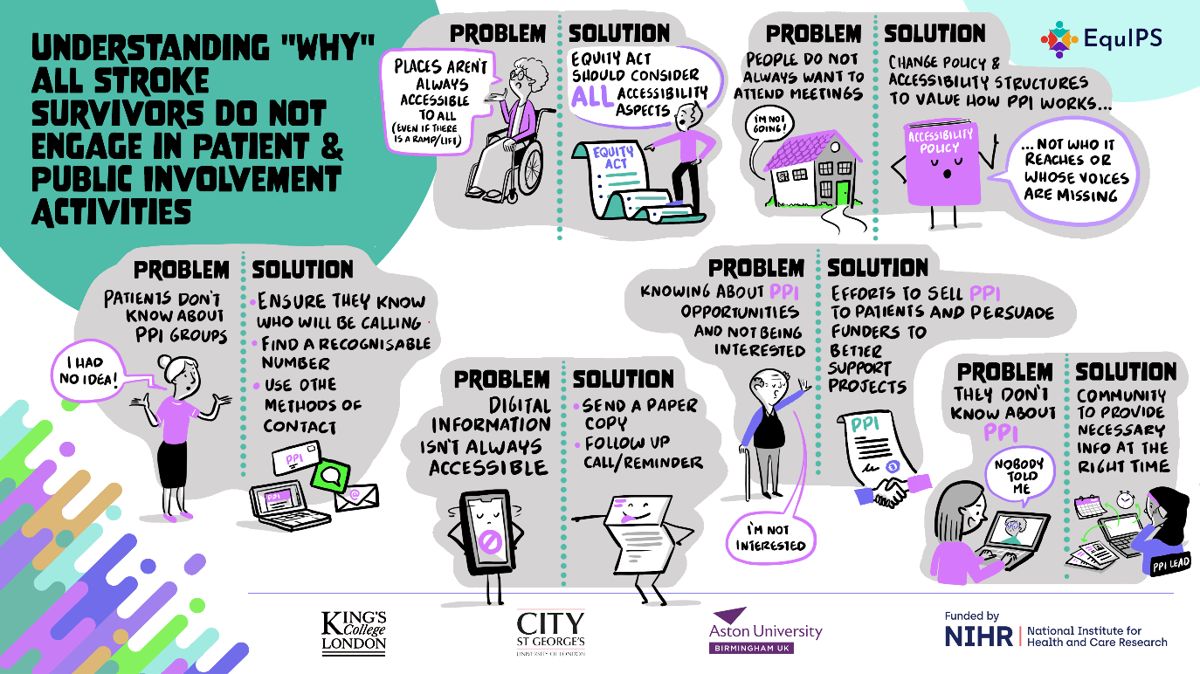
As noted in Respect and Inclusion, it is essential that researchers contact people and communities after they have taken part in involvement activities. This ensures that participants' feel their input and time are valued and builds trust for future involvement. This is particularly important in stroke, where involving those with more severe impacts of stroke is difficult, so nurturing ongoing relationships is particularly pressing. Follow-up after engagement activities should be prompt, accessible, and personal and works best in two stages:
- Following the activity, send a plain language summary that thanks people for their time, outline what was discussed and how their input will be used. In this communication, it is also important to include information on payment expenses and explain next steps. In cases where topics are emotionally sensitive, include a wellbeing check e.g. a named contact, an invitation to get in touch or links to support.
- Later in the project, tell people how their input has shaped the work, including (if relevant) whether a funding application has been accepted or not and the next steps. It is important to let people know your research plans, as this shows respect and keeps them included, even if the news may be disappointing.
People and community engagement require an ongoing dialogue between people and researchers in which they continue to be informed, respond and shape next steps within research.
The annotated resources list is currently under development. If you have resources you'd like us to consider, please share them and we will add them to the list.